Omnific Teach
Course-grounded knowledge access for training and education teams
Built for: Universities, training providers, and knowledge-heavy organisations
A working demonstration built by Omnific Hand to show our approach. Not a named client deployment.
The operational problem
Learners and staff were searching across PDFs, slide decks, intranet pages, and email threads to answer the same questions repeatedly. Training teams had no scalable way to give guided answers grounded in approved course material, and website visitors still had to hunt for basic information.
What we mapped first
- 1.
Reviewed which course materials were authoritative and how often they changed.
- 2.
Identified the highest-volume learner questions and where answers currently broke down.
- 3.
Defined when an automated answer was acceptable versus when a human tutor should step in.
- 4.
Scoped an embeddable assistant pattern for public sites as well as internal learning portals.
What we built
We built a learning platform with a retrieval-augmented teaching assistant that answers from approved course content, cites its sources, and can be embedded as a custom site widget for guided knowledge access.
- ·RAG assistant grounded in structured course modules and uploaded learning material.
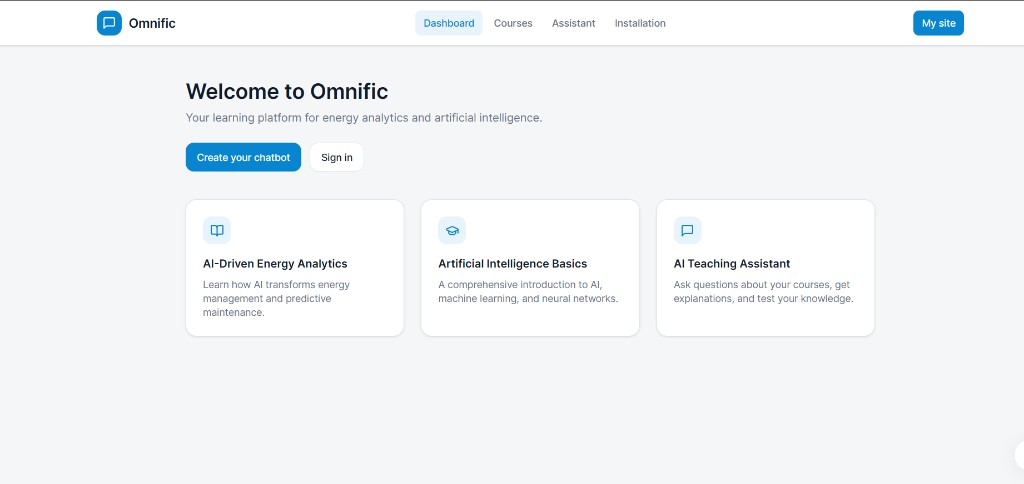
- ·Learner dashboard with course navigation and assistant access in context.
- ·Embeddable chat widget for public or internal sites with configurable behaviour.
- ·Admin-friendly content structure so training teams can update material without developer support.
How it works
Document ingestion and chunking pipeline for course PDFs, guides, and structured modules.
Retrieval-augmented generation with source attribution on each answer.
Web learning portal plus embeddable widget for third-party sites.
Course module structure, dashboards, and installation guidance for rollout teams.
Information handling and control
- ·Answers constrained to indexed course material rather than open web browsing.
- ·Source attribution so learners and moderators can verify responses.
- ·Access boundaries between public widget behaviour and authenticated learner areas.
- ·Content update workflow so outdated material can be removed from the knowledge index.
What the client receives
- ·RAG-based teaching and information assistant
- ·Structured course modules and learner dashboards
- ·Embeddable custom site widget
- ·Installation guide and chatbot configuration flow
- ·Handover documentation for content administrators
Product views
Course modules with in-context assistant access.
Answers grounded in course material with source references.
Embeddable widget pattern for public or internal sites.
What changed
- ·Learners can find course-grounded answers without waiting for tutor availability.
- ·Training teams reduce repetitive support load on common syllabus questions.
- ·Organisations can expose guided knowledge on their own sites without sending users elsewhere.
- ·The build demonstrates our approach to RAG with verification, not generic chatbot hype.
What a similar project costs
Knowledge assistant projects usually start with a proof-of-concept over a limited document set, then expand to production rollout.
| Engagement | Indicative range | Notes |
|---|---|---|
| Knowledge audit and scope | From £650 | Source mapping and access model |
| RAG proof-of-concept | From £1,500 | Limited corpus and admin UI |
| Production learning platform | £6,000 to £15,000+ | Portal, widget, and handover |
Final pricing depends on scope, integrations, data sensitivity, and deployment environment.
Build something similar
Tell us about your organisation, the process or knowledge problem, and any systems we should know about. We will reply with an honest view of scope and the right starting point.